
Volume 5 – St Gregory Palamas, Special series – Part 3
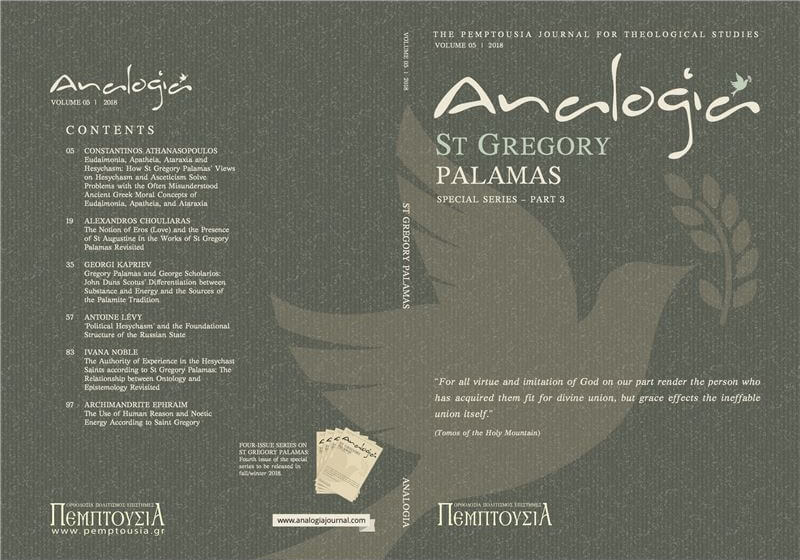
VIEW VOLUMEFor all virtue and imitation of God on our part render the person who has acquired them fit for divine union, but grace effects the ineffable union itself.
(Tomos of the Holy Mountain)
Contents-Abstracts
Editorial
This is the third volume of our special series dedicated to Saint Gregory Palamas. The fact that Analogia’s invitation to an issue dedicated to Saint Gregory Palamas has yielded so many academic responses of a high scholarly level has been exceptionally encouraging and revealing. The quality of many of the received articles obliges us to announce a fourth and final volume that will follow the present publication. We hope that these issues will be thought-provoking, and will make the discussion of Palamite work more substantial and profound.
In the first essay of this volume, Constantinos Athanasopoulos offers an original and thoughtful contribution to the ongoing discussion concerning Palamas’ reception and, most importantly, revolutionary transformation of some essential concepts of Ancient Greek moral philosophy, namely the concepts of Aristotelian eudaimonia, Stoic apatheia, and Epicurean ataraxia.… Continue Reading
This is the third volume of our special series dedicated to Saint Gregory Palamas. The fact that Analogia’s invitation to an issue dedicated to Saint Gregory Palamas has yielded so many academic responses of a high scholarly level has been exceptionally encouraging and revealing. The quality of many of the received articles obliges us to announce a fourth and final volume that will follow the present publication. We hope that these issues will be thought-provoking, and will make the discussion of Palamite work more substantial and profound.
In the first essay of this volume, Constantinos Athanasopoulos offers an original and thoughtful contribution to the ongoing discussion concerning Palamas’ reception and, most importantly, revolutionary transformation of some essential concepts of Ancient Greek moral philosophy, namely the concepts of Aristotelian eudaimonia, Stoic apatheia, and Epicurean ataraxia.
Fr Alexandros Chouliaras, in the second study, gives an insightful and balanced overview of Palamas’ use of crucial Augustinian concepts-such as eros-in his theology. The author summarises the various scholarly discussions on this topic and also makes his own suggestions concerning the limits of the Palamite use of Augustinian terms, along with the new meanings he gives to them.
Georgi Kapriev, in the third paper of this volume, provides an excellent overview of the recent discussion on the alleged Western turn of some prominent medieval Palamite thinkers, such as George-Gennadios Scholarios. Kapriev proves that, although Scholarios used the specific Western terminology of his time, he never thought he was saying something different from his teacher, Gregory Palamas, but on the contrary he sought to reinforce Palamas’ arguments.
Antoine Levy, in his insightful and challenging study, strives to reassess deeply the impact of the hesychastic teaching on divinisation upon the political philosophy of the medieval Russian state, and he also indicates some of its modern repercussions. Levy reopens an invaluable discussion and poses some difficult questions which cannot be ignored by anyone intending to study the modern political theory underpinning major political events of modern Russian history.
Ivana Noble reinstates, in her notable article, the immense importance of experience in Gregory Palamas’ theology. This is a skillful contribution, since this dimension is usually overlooked by scholars who tend to put Palamas’ ‘scholastic’ dimension above his existential commitment. Noble also criticizes Palamas’ excessive (as was usual for Byzantine scholars) rhetoric against his opponents, and poses some insightful questions concerning the relation between spiritual and natural knowledge.
Finally, Archimandrite Ephraim, the Abbot of the Holy and Great Monastery of Vatopedi, offers an erudite discussion on the distinction between reason (dianoia) and the intellect (nous), according to St Gregory Palamas, and the consequences of this in the life of created beings.
– Nikolaos Loudovikos, Senior Editor
The Use of Human Reason and Noetic Energy According to Saint Gregory
Saint Gregory Palamas, continuing the teaching of the earlier Fathers, distinguishes between man’s two cognitive faculties: reason (dianoia), which is related to logic, and the intellect (nous), which is related to immediate, intuitive perception. While reason is the vehicle of created knowledge, the logical power that can be expressed through reasoning about sensible and spiritual things, the intellect is the intuitive (noera) energy within man’s heart, which constitutes the means of divine vision, and becomes the only vehicle of the uncreated knowledge of God. The discovery of the intellectual (noera) energy within the heart of a man that lives in repentance contributes to the unification of the powers of the soul, to the purity of the heart, and to the acquisition of self-knowledge and firm faith, thus signalling the spiritual completion of man through participation in the uncreated deifying energies.
In his second homily On the Entrance of the Mother of God, where he presents our Lady as a model of the hesychast life, Saint Gregory Palamas discusses at length the five powers of the soul: sense, imagination, thinking, intellection, and nous.1 Here, the great anatomist of the human soul makes the distinction that intellection is the power of reason which, through a variety of successive syllogisms, completes
The Authority of Experience in the Hesychast Saints according to St Gregory Palamas: The Relationship between Ontology and Epistemology Revisited
Does a direct experience of God and the associated grace-filled transformation make people infallible, or can even saints still be wrong when they interpret who can be saved and who cannot, what forms of life people should choose, which political systems, figures and positions they should support? This article examines what St Gregory Palamas says on the nature of the saints’ experience and knowledge, how stability and progress are interrelated in his notion of deification, and what the consequences are of his differentiation between knowledge coming from above and natural knowledge.
Among the reasons for the appreciation of St Gregory Palamas in twentieth and twenty-first century theology is undoubtedly his emphasis on the real presence of God in creation, and, in particular, in the human experience of being reached, purified, and transformed by God, who through his grace joins to himself whom he wishes. It could be argued that his essence-energy distinction, or his accounts of the psychosomatic techniques of prayer, all serve this one goal: to defend the reality of divine-human communion. Preserving divine simplicity, on the one hand, and the possibility of human deification, on the other, Palamas argued that the eschatological divine fullness of life can irrupt into this life, as in the case of Christ’s Incarnation. Through Christ, it can transform people who are found worthy to see this fullness in terms of the uncreated deifying light In this article, I will examine the epistemological consequences of the direct experiences of and participation in God. My basic question will be: according to Palamas, does the experience of the deifying light make holy men and women infallible in their theological statements, in their discernment of what are, and what are not, good morals or even good political decisions?
To answer this question, the different layers that we need to be aware of in Palamas’ experiential theology will first be considered. Then, the conditions under which
‘Political Ηesychasm’ and the Foundational Structure of the Russian State
The expression ‘political hesychasm’ was coined by late Soviet historiography. It designates the con tribution of the spiritual renewal initiated by Gregory Palamas to the dramatic rise of the Muscovite State between the fourteenth and sixteenth centuries. The present paper argues that this influence runs much deeper than previously assumed. Behind what foreign visitors described as a species of oriental despotism, there is a brilliant translation of the hesychastic process of divinisation into political terms.
Despite its relative diffusion in the recent years, one is entitled to wonder whether the notion of ‘political hesychasm’ carries more meaning than that of a round square. It is difficult not to agree with the manner in which S. Khoruji singles out this inherent hiatus:’ [Hesychasm] is a specific activity of the human subject, an activity that leads it to actually and ontologically transcend and modify the fashion of its existence. As such, this activity is characterised by an aspect of foreignness when it comes to the whole sphere of human empirical concerns, which includes social, cultural and political practices’.1 In contrast to modes of prayer that aim at improving the material conditions of human personal and collective existence-or, to put it more theologically, at paving the road to God’s Kingdom on Earth-the hesychastic way that Palamas justified on dogmatic grounds is about accessing, through the practice of asceticism and mental prayer, a transforming reality that is fundamentally foreign to the coordinates of space and time-those that precisely define the horizon of political thinking. True, minds bent on ideological or confessional controversies will always be able to politicise the most apolitical type of human activity. Still, as Khoruji observes: ‘The political sphere has an anthropology of its own, its own rigid patterns of conduct and strategies of action. These are deeply foreign to the hesy-
Gregory Palamas and George Scholarios: John Duns Scotus’ Differentiation between Substance and Energy and the Sources of the Palamite Tradition
Georgios Scholarios, Patriarch of Constantinople from 1454 under the name Gennadios II, formulated the ‘essence-energy’ distinction, emblematic for the Byzantine tradition, using the scheme of Duns Scotus: the figure of distinctio formalis a parte rei. Today, some scholars attempt to contrast Scholarios’ solution with the concept of distinctio realis, which they ascribe to Palamas, thereby seeking to demonstrate an incom mensurability between the two. The thesis suggested by this perspective is that, in making use of Latin (Thomistic, but also Scotist) metaphysical logic, Scholarios shsows a way out of the deadlock to which the philosophical clumsiness of Palamas and of his direct successors had lead. From this point of view, many assert that Scholarios’ position is non-Palamite or at best nominally Palamite. The purpose of this text is to critically compare the positions of Scholarios and Palamas, thus clarifying the following questions: Does the Palamite tradition dispense with its own internal resources to formulate Scholarios’ solution? What is Scholarios’ attitude towards the Western tradition?
George Scholarios 1 (called Gennadios II, Patriarch of Constantinople, following his enthronement in 1454) is portrayed as a ‘Byzantine Thomist’, even ‘the greatest of the Byzantine Thomists’, 2 although he acted as the leader of the Palamite party in Constantinople from 1444 onward. At the time, he was mainly thought of as belonging to the pro-Thomists in Byzantium, although it became clear early on that he was open to several schools of thought, which wrought minor influences on his approach.3 As early as the beginning of the 1930s, Martin Jugie supported the thesis-which remains influential in our current era-that in his formulation of the essence-energy distinction (emblematic both of Byzantine philosophy and systematic Palamism) Scholarios relies on the scheme of distinction employed by
The Notion of Eros (Love) and the Presence of St Augustine in the Works of St Gregory Palamas Revisited
‘Since one of the wise and apostolic men says…’ 1
The article revisits the use of certain Augustinian expressions and passages in the works of St Gregory Palamas, mainly regarding the Trinitarian reflections in man, the imago Dei, and the notion of eros (love). First, we present Palamas’ theology regarding the eros of the nous (intellect) for its logos. Second, we provide a brief review of the literature regarding the Augustinian presence in Palamas, and then continue with our assessment of this presence. We demonstrate that Gregory does indeed borrow phrases from Augustine, but he does not always use or incorporate the latter’s ideas; sometimes (e.g., in the case of the Filioque) he even comes to the opposite conclusion. In other words, despite similarities, one also finds crucial differences between Augustine’s and Palamas’ relevant approaches. Finally, four possible reasons—not often stressed in scholarship; the third probably mentioned for the first time—are proposed to explain why Palamas takes up the notion of eros from the Bishop of Hippo: a) the ‘eternal rest’ (ἀίδιος ἐπανάπαυσις) of the Holy Spirit on the Son; b) his willingness to oppose the Filioque; c) the appeal to a major notion in Palamas’ anthropology, namely the ‘vivifying power’ (ζωοποιὸς δύναμις) of the human soul; and d) the Holy Spirit’s ‘eternal resplendence’ (ἀίδιος ἔκλαμψις/ἔκφανσις). In conclusion, it is argued that this endeavour of Palamas could nowadays also inspire Orthodox theology in its effort to engage in dialogue with Western thought and in its attempt to articulate a genuine and persuasive voice in our era.
The Eros of the Nous (intellect) for its Logos 2
A very contentious subject in the recent literature has been the presence, or lack thereof, of St Augustine in St Gregory Palamas’ writings, 3 and especially in his
I am grateful to Revd Prof. Andrew Louth, Revd Dr Demetrios Bathrellos, and Archim. Dr Maximos Constas for having read earlier drafts of this text and providing important feedback, and to Mr Vincent DeWeese for proofreading my English; moreover, to the anonymous peer reviewer, whose remarks helped me improve the article and bring it to its final form. Of course, for all possible shortcomings, the author alone is responsible.
Eudaimonia, Apatheia, Ataraxia and Hesychasm: How St Gregory Palamas’ Views on Hesychasm and Asceticism Solve Problems with the Often-Misunderstood Ancient Greek Moral Concepts of Eudaimonia, Apatheia, and Ataraxia
In this work, I examine how we can use St Gregory Palamas’ views on hesychasm and asceticism to solve key problems associated with Aristotelian eudaimonia, Stoic apatheia, and Epicurean ataraxia. The problems of social interaction and lack of knowledge regarding the intentions of others presents a serious problem for Aristotelian eudaimonia. For Epicurean ataraxia, the fleeting nature of pleasure presents further problems, and the Stoic ideal of apatheia is too stable to be real. St Gregory Palamas knew these limitations of Ancient Greek ethics very well and proposed hesychia and ascesis as the true answer to moral dilemmas and the pursuit of true eudaimonia.
Introduction: Why is this Topic Relevant to Palamite Studies?
It is almost seven hundred years since the Orthodox Church declared that the positions of Barlaam and his follower Akindynos were heretical and should be condemned, at the Council of 1341 (which is regarded by many as the Ninth Ecumenical Council, and is otherwise known as the Fifth Council of Constantinople). Gregory Palamas was declared a saint in 1368, and soon after, the Orthodox Church asserted that the Sunday following the Sunday of Orthodoxy during Lent was to take his name, so as to remind believers that Palamas’ theology is a continuation of Orthodox theology upholding the veneration of icons, which was defended at the Seventh Ecumenical Council of 787. During the Sunday of Palamas, the Hagioritic Tome (a text signed by the Holy Community of Mt Athos and other Orthodox Church representatives which condemns the heretical positions of Barlaam and his two followers, Akindynos and Gregoras) is traditionally read at the Patriarchate of Constantinople and Orthodox monasteries worldwide to remind believers of the