
Volume 7 – Byzantine Aristotle
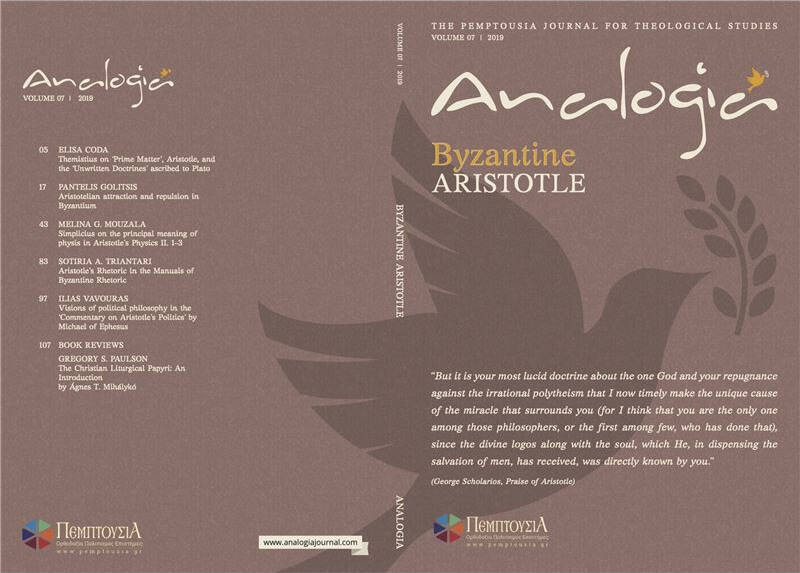
VIEW VOLUMEBut it is your most lucid doctrine about the one God and your repugnance against the irrational polytheism that I now timely make the unique cause of the miracle that surrounds you (for I think that you are the only one among those philosophers, or the first among few, who has done that), since the divine logos along with the soul, which He, in dispensing the salvation of men, has received, was directly known by you.
(George Scholarios, Praise of Aristotle)
Contents-Abstracts
Editorial
Although the existence and the specificity of Byzantine Philosophy are widely recognized today, it is nonetheless true that we might still need a series of explorations in order to get closer to its ultimate importance, not only for the construction of Greek Patristic theology, but also for a deeper interpretation of Greek Philosophy as such. Most of the Byzantine philosophers are not just slavish interpreters of the latter, but also creative thinkers, sometimes even able to correct or transform the philosophical data.
In an attempt to engage with the modern understanding of such a fertile enterprise as Byzantine Philosophy, Analogia offers this first collection of distinguished essays written by promising experts of the younger generation, which comprise a good part of the essays received by the Journal once the invitation for a Byzantine Aristotle volume was extended to the academic community.… Continue Reading
Although the existence and the specificity of Byzantine Philosophy are widely recognized today, it is nonetheless true that we might still need a series of explorations in order to get closer to its ultimate importance, not only for the construction of Greek Patristic theology, but also for a deeper interpretation of Greek Philosophy as such. Most of the Byzantine philosophers are not just slavish interpreters of the latter, but also creative thinkers, sometimes even able to correct or transform the philosophical data.
In an attempt to engage with the modern understanding of such a fertile enterprise as Byzantine Philosophy, Analogia offers this first collection of distinguished essays written by promising experts of the younger generation, which comprise a good part of the essays received by the Journal once the invitation for a Byzantine Aristotle volume was extended to the academic community.
In her learned and accurate ‘Themistius on “Prime Matter”, Aristotle, and the “Unwritten Doctrines” ascribed to Plato’, Elisa Coda pertinently shows that Themistius was inspired by a loose harmony between Aristotle’s conception of matter and Plato’s interplay of determination and indetermination, in order to explain ‘prime matter’ as the principle of indetermination—thus showing, once again, the philosophical creativity of the great commentator.
Pantelis Golitsis, in his highly documented ‘Aristotelian attraction and repulsion in Byzantium’, offers a brilliant short history of the reception of Aristotle in the Byzantine intellectual world. While rightly claiming that neither Aristotle nor Plato were ever received as an organic and indispensable part of doing theology, he nonetheless shows that ultimately, not only were Aristotle’s Logic or Physics positively accepted, but even his metaphysical monotheism was highly praised by an intellectual of the status of Scholarios, and the philosopher’s capability of instilling the right convictions about the knowledge of God in this world was acclaimed by an intellectual of the status of Pachymeres. Of course, this does not mean that the suspicions about his deeper theological convictions were ever silenced.
Melina Mouzala in her excellently elaborated ‘Simplicius on the principal meaning of physis in Aristotle’s Physics II. 1–3’, which shows a deep familiarity with her research area, shows how original, multi-leveled, and fertile Simplicius’ under- standing of the Aristotelian physis is. I think that no student of the history of such an influential concept for the very articulation of theology and medieval thought in general, like that of physis, can afford not to read this article. Simplicius final under- standing of physis as escate zoe, is utterly important for the history of both Christian Philosophy and Theology.
Sotiria Triantari, an expert in Byzantine rhetoric, in her ‘Aristotle’s Rhetoric in the Manuals of Byzantine Rhetoric’ shows successfully to what extent—and despite some criticism by prominent Byzantine intellectuals—the Aristotelian Rhetorics, along with the philosopher’s theory of language, became the foremost source of inspiration for the Byzantines.
Ilias Vavouras, finally, in his insightful ‘Visions of political philosophy in the “Commentary on Aristotle’s Politics” by Michael of Ephesus’, brilliantly shows how the Byzantine intellectual not only accepts, but also christianises the Aristotelian perspective, by closely connecting governance with virtue and especially justice.
– Nikolaos Loudovikos, Senior Editor
Themistius on ‘Prime Matter’, Aristotle, and the ‘Unwritten Doctrines’ ascribed to Plato
On close inspection, Themistius’ rephrasing of two passages in Physics IV 2, in which Aristotle compares Plato’s Timaeus and the ‘unwritten doctrines’, suggests that he was guided in his understanding by a loose association with the account of Plato’s Ideas in the Metaphysics. Themistius also interprets Aristotle’s remarks about ‘place’ in Timaeus as pointing to the main feature of ‘prime matter’, namely indetermination.
I
Themistius1 was a prominent figure in education and government in fourth century Constantinople, where he also ran his philosophical school.2 He authored both rhe- torical works (Orationes) and paraphrases of Aristotle’s treatises3 and was even in his lifetime considered a key personality in the philosophical education of the cultured
General presentations of Themistius include, in chronological order: Robert B. Todd, ‘Themistius’, in Catalogus translationum et commentariorum, vol. VIII, eds Virginia Brown et al. (Washington, D.C.: The Catholic University of America Press, 2003), 57–102; Elisa Coda, ‘Themistius, Arabic’, in Encyclopedia of Medieval Philosophy, ed. Henrik Lagerlund, (Dordrecht: Springer, 2011), 1260–66; Jacques Schamp, Rob- ert B. Todd, and John Watt, ‘Thémistios’, in Dictionnaire des Philosophes Antiques VI, ed. R. Goulet (Paris: CNRS Éditions, 2016), 850–900; Michael Schramm, ‘Themistios (§ 40)’, in Grundriss der Geschichte der Philosophie. Die Philosophie der Antike 5/1: Philosophie der Kaiserzeit und der Spätantike, eds Christoph Riedweg, Christoph Horn, and Dietmar Wyrwa, (Basel: Schwabe, 2018), 410–427, 451–455 (bibliography).
From about 345 CE, Themistius taught at Nicomedia; later on, at Constantinople: cf., Or. 31 and Or. 24, 302C–303A.
According to some, Themistius also authored commentaries properly speaking: cf., Carlos Steel, ‘Des commentaires d’Aristote par Thémistius?’, Revue philosophique de Louvain 71 (1973): 669–80; against this hypothesis, cf., Henry J. Blumenthal, ‘Photius on Themistius (Cod. 74): Did Themistius Write Commentaries on Aristotle?’, Hermes 107 (1979): 168–82; John Vanderspoel, ‘The Themistius’ Collection of Commentaries on Plato and Aristotle’, Phoenix 43 (1989): 162–4.
Aristotelian attraction and repulsion in Byzantium
The present article provides an overview of Aristotle’s fate in Byzantium from the eighth to the fifteenth century. In opposition to accounts that consider Byzantine philosophy either as a mere continuation of Greek philosophy or as neutrally disposed towards it, the article argues that the reception of Aristotle’s philosophy in Byzantium (like the reception of Plato’s philosophy) oscillated between enthusiastic approval and vehement rejection: some Byzantines argued in favour even of Aristotle’s theology, assessed as admirably monotheistic, whereas others associated Aristotelian science with heresy and Thomism. The article discusses these two extreme positions in conjunction with the moderate assessment of the Stagirite in Byzantium, which focused on his logic and on topics of his physics in accordance with Byzantine eclecticism.
Just as it happened in the Latin West, so it also happened in the Byzantine East: Aristotle was always omnipresent either in a positive or in a negative way; his philosophy was either admired and espoused or downgraded and dismissed. Contrary, however, to the intellectual concerns of their Western peers, whose interpretation of Aristotle was largely shaped by the Arabic tradition (most importantly, through the commentaries of Avicenna and Averroes), in which philosophy appeared free from religious concerns, the Byzantine philosophers did not usually argue about how to interpret Aristotle’s philosophy. Instead they mostly argued about its use and its overall value. To take a prominent example, the claim for the unity and singularity of the human intellect, which came to be known as Averroism in the Latin West in the thirteenth century, was rejected by Thomas Aquinas precisely as a false interpretation of Aristotle’s noetics; indeed, Averroes himself and the Averroists at the University of Paris put forward the doctrine of the singular human intellect as an accurate interpretation of the passive intellect, which Aristotle discusses in his treatise On the Soul III 4–5. There is no doubt, of course, that Thomas was committed to rejecting Averroism for the benefit of the Christian doctrine on the immortality of the individual soul. But what matters for my present purpose is that he did so through what he put forth as a correct interpretation of Aristotle’s text. Thomas had also battled against the so-called ‘doctrine of the double truth’, usually associated with Boethius of Dacia and Siger of Brabant, that is, the doctrine which separates the
Simplicius on the Principal Meaning of Physis in Aristotle’s Physics II. 1–3
At the beginning of his Commentary on Aristotle’s Physics II.2, Simplicius attempts to reveal the principal meaning of physis, that which in his view is preeminent above all others presented by Aristotle in Physics II.1. Through the arguments he uses to show what the principal meaning of physis is, we are also able to better understand the other meanings. These other meanings are, on the one hand, those which can be indisputably traced in the Aristotelian text itself, and on the other, those which are discovered in the light of Simplicius’ insightful reading of it. Simplicius appears to recognize—or at least to be conscious of the fact—that this part of his Commentary constitutes an autonomous analysis and explanation of the different meanings of physis, which sets out to reveal its concealed principal meaning. My aim in this paper is to show that in his comments on Physics II.1, Simplicius is trying to offer an exegesis of the Aristotelian arguments, while in his comments regarding the beginning of Physics II. 2, he proceeds to a bold reading of what Aristotle has said in chapter one. He does this by giving his own interpretation of the meaning of physis, within the frame which Aristotle had already sketched out in the previous chapter, but also by deviating to some extent from Aristotle. For Simplicius the principal, albeit concealed, meaning of physis, within the Aristotelian philosophical framework, lies in the idea that nature is a sort of propensity for being moved and a sort of life, to wit, the lowest sort of life (eschatē zōē).
Ι
The differentia specifica of things that exist by nature and the definition of physis
in the Physics II.1
In the first half of chapter one of Physics II, Aristotle explains that all natural things are clearly distinguishable from those that are not constituted by nature.2 According
An earlier draft of this paper was presented at the ‘I Simpόsio Ibérico de Filoso a Grega: Aristόteles e o Aristotelismo’ [I Imperian Symposium for Greek Philosophy: Aristotle and Aristotelianism], Centro de Filoso a da Univesidade de Lisboa, Faculdade de Letras da Univesidade de Lisboa, Lisbon, September 25–26, 2014.
Physics 192b 8–13. I follow the translation by Philip Henry Wicksteed and Francis Macdonald Cornford (Aristotle, Physics, Volume I: Books 1-4. Loeb Classical Library 228 [Cambridge, MA: Harvard University Press, 1957]).
Aristotle’s Rhetoric in the Manuals of Byzantine Rhetoric
Aristotle was the first ancient philosopher to draft a manual of rhetoric containing the definition of rhetoric, its relation with dialectic, the norms of rhetoric, rhetorical techniques, the presentation of the orator’s personality, the psychological and logical persuasion required of an orator, as well as his communication skills, both verbal and non-verbal. The content of Aristotle’s rhetoric, despite the harsh criticism of Byzantine philo-Platonist Theodore Metochites, constituted a source of inspiration for the Byzantines, who wrote few commentaries on Aristotle’s rhetoric, but adopted many elements from his manual in order to express their socio-political ideology through the perception of the aesthetically verbally beautiful. Particularly significant is the fact that the Byzantines inherited from Aristotle the first communication model that was based on the threefold use of language: the theoretical, the practical and the productive or artistic. Frequently, Aristotle’s theory about language in relation to that of Isocrates is found in Byzantine manuals of rhetoric. Aristotle’s rhetoric had a significant impact on the Byzantine perception of the aestheticality and practicality that must imbue the orator’s speech in order that the communicative interaction with his audience be improved. In this way, communication in its modern form was polished by the Byzantine’s contemplation on aesthetically beautiful speech in style and verbal forms.
Introduction
Rhetoric rapidly occupied a significant position in Byzantine literature and in the life of the Byzantines, because the Byzantines used rhetoric to externalise their spiritual world and manifest their aesthetic perceptions of art.1
Some Byzantine scholars drew up manuals of rhetoric based mainly on Hermogenes’ rhetoric, as well as that of Aristotle. Many commentaries were written on Hermogenes’ rhetoric, which was the most basic source for the Byzantines. From the fourth to fifth century, interest in Hermogenes’ rhetoric was strengthened by commentaries written by neo-Platonists, such as Syrianos. The representatives of the Alexandrian School displayed particular interest in Aristotle’s rhetoric.2
Hans Georg Beck, ‘The Byzantine rhetoric as an expression of the Byzantine spirit’, Journal of Research in Philosophy 9 (1965): 102.
George L. Kustas, Studies in Byzantine Rhetoric (Thessaloniki: Patriarchal Institute of Patristic Studies, 1973), 7–8. Kustas also mentions that there were Byzantines who commented on Apthonius’ Progymnasmata, who was a student of Libanius (second half of the fourth century).
Visions of political philosophy in the ‘Commentary on Aristotle’s Politics’ by Michael of Ephesus
In this work, in the fragmentary Commentary on Aristotle’s Politics, Michael of Ephesus (1059–1129) says that in nature there are relations of sovereignty and subordination. This relationship validates the view of natural slavery, that there are masters by nature and slaves by nature. The organic use of the slave by the master or of the subject by the sovereign resembles the sovereignty of the soul over the body. In addition, Michael points out that the differentiation between politicians and citizens is not just about governance and subordination, but also about the issue of virtues. A real political man would be an exemplary form of expression of the private and public application of the virtue of justice. This article, I think, highlights the political philosophy in Byzantium and specifically the Aristotelian political philosophy, as it is understood and developed by important thinkers of the same period, such as Michael of Ephesus.
If we want to deal with political philosophy in Byzantium, and specifically with Aristotelian political philosophy, we cannot ignore the fragmentary commentary on Aristotle’s Politics by Michael of Ephesus (1059–1129). In this study, the Byzantine thinker addressed the basic problems of Aristotelian thought and political philosophy in general, attempting to interpret basic directions of Aristotelian political philosophy, but also to integrate them into the political model of the Byzantine Empire.
The ruler as a simulation of the divine mind
A structural parameter of Michael’s thought is the perception of political governance as a simulation of divine dominance in the universe. This idea is not new but is inherited from the ancient Greek tradition and specifically from the Pythagoreans. According to the Pythagoreans, the communication between the parties of a political community must be modelled on the communication between the different parts of the universe. The universe, however, was not created accidentally, but it was a product of rational design.