
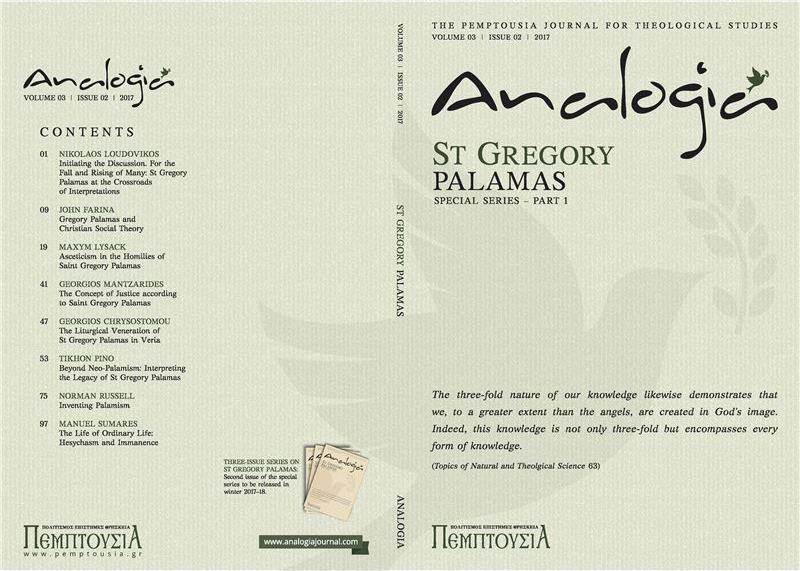
Volume 3 – St Gregory Palamas, Special series – Part 1
VIEW VOLUMEThe three-fold nature of our knowledge likewise demonstrates that we, to a greater extent than the angels, are created in God’s image. Indeed, this knowledge is not only three-fold but encompasses every form of knowledge.
(Topics of Natural and Theological Science 63)
Contents-Abstracts
Editorial
Initiating the Discussion – ‘For the Fall and Rising of Many’:
St Gregory Palamas at the Crossroads of Interpretations… Continue Reading
Initiating the Discussion – ‘For the Fall and Rising of Many’:
St Gregory Palamas at the Crossroads of Interpretations
As an unfailing sign of his spiritual greatness, St Gregory Palamas continues to be a stumbling block for Western and some Eastern theologians alike, and he still emerges like a lonely island in the midst of Christian theology ‘for the fall and rising of many’ (Luke 2:34). Non-Orthodox theologians avoid or reject him, not only because they constantly misinterpret his doctrine of uncreated energies as ‘innovation’ (from Denis Petau to Martin Jugie and Robert Jenson) but also because they suspect him of refuting certain fundamental Western theological concepts concerning grace, synergy, divine unity, the Filioque, etc. Some Orthodox theologians, on the other hand, have become ‘Palamophobic’ for some complicated reasons, mainly due to the misunderstanding of the function of selfhood and the significance of psychosomatic participation in Hesychasm, something I have sought to analyse in my book, Beyond Spirituality: Christian Mysticism of Power, and the Meaning of the Self in the Patristic Era.1 But are there any further historical reasons for this ‘conflict of interpretations’, to recall Paul Ricœur?2 As I wrote recently:
The difficulty with Hesychasm is that its absorption into scholarship was interrupted suddenly and early. The gradual collapse and eventual fall of the Empire, the resultant decapitation of the Roman-Greek nation’s scholarship in the fifteenth century, the terrible vicissitudes of the centuries-long, barbarous occupation, and, thereafter, the impositions of the West and the brutal clashes over confessions for a long time forced the Eastern Church to put its energies into preservation and conservation. The Orthodox Church in Russia was unable to undertake the task for the reasons described by Florovsky.3
First, this prevented a real, in-depth dialogue after the Hesychast councils between the victors of the Hesychast conflict—the Hesychasts like Palamas, Cabasilas, Kokkinos, and, later on, Markus Eugenikos et al.—and those who were defeated—the Westernizing opponents and their pupils. Second, it prevented a real and deep dialogue with the West, something for which many Western theologians, with their strong confessionalism, are also responsible. George-Gennadios Scholarios, in the fifteenth century, started a deep, unprecedented, and learned dialogue with the West, but by then it was no longer possible to truly hold such a major spiritual and cultural event within the collapsing Byzantine intelligentsia. The same is true concerning people like Vikentios Damodos, the great and erudite theologian of the eighteenth century, whose work is, ironically, in great part, still unpublished. There were two appalling consequences as a result of this situation. First, Hesychasm gradually gave the impression of real and substantive opposition to humanism, both classical and medieval, and to the natural, cosmological, and, in part, metaphysical dimensions of philosophy, whereas in fact it represented a drastic reacquisition, critique, and transformation of all these (even though this was formulated largely through thinking and experience, rather than in a systematic manner). It is therefore unfortunate, but true, that a good deal of obscurantism has crept in to Orthodox theology, especially in recent years, making it impossible to hold the potentially invaluable dialogue between Hesychasm and the human sciences and philosophy, which would provide these with new horizons. The second disastrous effect is that Hesychasm was understood as having an a priori anti-Western orientation and impetus, something which is of course untrue, since Palamas, along with his cleverer pupils in the centuries that followed, never condemned Augustine or Thomas Aquinas; many Western theologians are also responsible for this supposed hostility since, out of their inability to properly understand Palamas, they created a swarm of monstrous myths about Palamas and Hesychasm, to such an extent that even now all the good and faithful Catholic scholars feel unconsciously compelled to express a sort of theological nausea when they encounter Palamas and his ancient or modern proponents. It is impossible to find even one Western scholar who completely rejects Palamas due to a deep knowledge of his theology.4
Moreover, and in continuity with the above difficulties, there perhaps exists another series of critical ‘factors’ that have to be taken into serious consideration by both pro-Palamites and anti-Palamites in order for an honest dialogue to be established. The first factor can perhaps be called ‘the battle of intentions’. What are our ultimate theological intentions when dealing with the Palamite corpus? Is what we usually call an ‘irenic’ and ‘balanced’ (sterilized!) academic approach enough to fathom the wuthering heights and burning depths of St Gregory’s ‘existential’ treasury, acquired in the years of his hermetic self-enclosure in his remote cave at the Veria Skete, where he passed the years of his youth crying to God, ‘Illumine my darkness’? How many of us know, in an existential manner, something about this ‘darkness’ and the quality of its possible ‘illumination’? However, these are not pious excesses, but excessive ‘saturated phenomena’, to use Marion’s phenomenological language,5 and something even more profound than this. How many mistakes and how many self-sufficiently blissful misunderstandings of Palamite thought would have being avoided had scholars been able to partake, even just a little, of his divine music? Or, alternatively, how much better would it be to respect what we do not possess and consent to learn from Palamas, instead of putting him constantly upon the Procrustean bed of our narrow and self-sufficient academic mediocrity? It is simply impossible to truly understand Palamas and others like him, East and West, by simply using our habitual scholarly methods and projects. At the same time, Palamas requires another sort of spiritual intention on our part in order to be fathomed. If approached in this way, the synodical reception of St Gregory by the Orthodox Church is not without meaning.
The second factor that must be considered relates to ‘cultural wars’. If on the flag of the anti-Western Orthodox warriors of this long warfare—cultural in its hidden core—is written ‘Spiritual East versus Scholastic West’, then on the flags of the contemporary Western (mainly Roman Catholic) anti-Eastern apostles following Jugie’s polemics is inscribed ‘Correct the mistaken Greeks’. If the tension is viewed in this light, there is no value in discussing the difference between Palamas and Thomas Aquinas or Augustine, nor, of course, Duns Scotus. In the view of the anti-Eastern ideologues, Palamas is but a cachectic hybrid of the three western thinkers. Conversely, the so-called ‘Palamite school’—and especially the poor ‘Neo-Palamites’, an expression used by these authors when they want to pour scorn on the work of any Orthodox theologian who disagrees with their methods—represents a parasitic ideological obsession. It is a sort of theological ‘imagined community’—to quote Benedict Anderson—of modern theologians who fight against the perennial glory of Western theology. Furthermore, as these anti-Palamites claim, those modern pro-Palamites have not understood that the very heirs of Palamism had already associated it with the thought of the intellectual giants of the West, and had even altered essential elements of St Gregory’s theology. The exponents of this ideological rather than theological approach implicitly follow Jugie, though they have paradoxically reversed his main argument (i.e. that Gregory was a theological ‘innovator’); these authors, through similar terms possibly found in the writings of different thinkers, tend to establish absolute identifications of meaning. They use philological weapons in order to hide either their lack of genuine theological positions or seek to fulfil the ancient dream of subordinating ‘dissident’ (to again recall Jugie) Eastern theology to blissful obedience to the Holy See—as if such subordination or uniformity ever existed in the united Church of the first millennium. However, it is truly refreshing that today there are some serious scholars, both East and West, who, while being fully aware of the differences between the two theological traditions, search for ways of possible theological communication, dialogue, and, perhaps, a critical convergence, through the use of theological and philosophical criteria. In the East, it is possible to find such scholars even as early as in the fifteenth century. This class of thinkers, East and West, realise that Palamas was not the author of an ‘innovation’ called ‘Palamism’, but that he simply brought our common Patristic tradition to a point of theological maturity, thus responding to exciting anthropological and spiritual problems of his era. These same thinkers also recognise the fact that he was never ‘abandoned’ or substantially ‘altered’ by his theological heirs.
A third factor relevant to this discussion is the ‘spiritual controversies’. It is of utmost importance to admit that discussions about, for example, the possibility of understanding life in Christ as psychosomatic participation rather than intellectual contemplation are not without meaning, since they affect the very understanding of our Christian identity. A discussion concerning the quality of grace received by the Christian—created or uncreated—is not just a scholastic debate but decisively affects our way of living spiritual life. If grace is created, then spiritual life has some obvious limits within my human world, and, moreover, as I argue elsewhere, real divine presence in my created world can, on a metaphysical level, be doubted.6
Yet a fourth factor is ‘the Trinitarian quarrels’. Palamas did not accept the Western conception of the Filioque, but he nonetheless offered the theological criteria for an Orthodox interpretation thereof. It is also of great theological importance that it is possible for us to discuss, in a most fruitful manner, the Filioque through his doctrine of the distinction between the divine essence and energies.7
Therefore, to search for the merits Palamas’ thought could potentially bring to ecumenical Christian theology is perhaps not a vain pursuit, provided that it is respected and first interpreted by its own intellectual and spiritual criteria, and only then in dialogue with modern theological and secular thought. Could, perhaps, the following personal open suggestions—and this is why I refer here only to my own works, in which I expound these issues, building of course upon the work of many great Orthodox scholars, starting with George-Gennadios Scholarios, and Vikentios Damodos, and ending with Florovsky, Staniloae, Meyendorff, Bulgakov and Lossky—serve as an unconventional way to initiate this serious discussion, and show precisely how serious this discussion can be? I call these suggestions open because I understand them as parts of an ongoing dialogue, rather than fixed convictions. As the reader shall see, the authors in the present volume as well as in those forthcoming will have different suggestions to make. These suggestions are elucidated in the following points:
- St Gregory Palamas created an unparalleled metaphysics of the real presence of God in creation, based upon Greek Patristic theology of the first millennium, along with a deeper understanding of divine Christian theology can profit considerably from this theological metaphysic.8
- Palamas created a theological theory of psychosomatic participation in God, explicitly beyond merely intellectual contemplation.9
- He endorsed a holistic understanding of human existence, beyond the temptations of any detached or ecstatic theological mysticism of the mind or of the heart. His theology of prayer involves an entire theory of human unification.10
- St Gregory represents for the Orthodox a way of a positive understanding of both Augustine and Thomas Aquinas, and even, as I suggested recently, a way of a possible theological corrective to some points of their theology.11
- He can help us to understand why the Filioque is a problem for the East, and how it may be solved.12
- The Archbishop of Thessalonica can open new perspectives in the modern dialogue between theology and philosophical anthropology, depth psychology, and even biological psychology or cognitive science.13 Some contemporary Orthodox scholars already have put the doctrine of the uncreated energies successfully in dialogue with modern physics.
- He can offer exciting material for a step-by-step construction of a non-abstract modern social theory.14
- The hesychast saint offers exciting theological perspectives for a new understanding of the philosophy of history.15
- Palamas offers fertile perspectives to the recent discussions of the ontology of personhood, through what I have called his theology of inter-hypostatic syn-energy.16
- Finally, he can also show how this life of divine participation is deeply connected with ecclesiology, if it is considered to be, as I have called it elsewhere, a ‘lived ecclesiology’.17
Analogia’s announcement of a two-issue series on St Gregory Palamas provoked an unexpected number of responses of high academic quality, and it therefore seems that, in the end, we have a sufficient number of articles to produce a three-issue series. I hope that this will help towards the deepening of this extremely necessary dialogue for the sake of our common Christian theological endeavour today. As indicated in the mission statement of the journal, the floor is open for anyone who would like to respond to any of the articles published in these issues; the author will then be asked to respond, if he/she wishes.
Now, concerning the present volume, the following articles are included: Professor John Farina starts the volume by offering an exciting corrective to the Christian social justice industry through Palamas’ theology of an inward transformative experience and vision of God, and against secularism, which is unconsciously endorsed even by some Christian social theories, starting with Scholasticism and ending with Liberation theology; this article is capable of inaugurating a most fruitful discussion. Fr Maxym Lysack offers an overview of asceticism in light of the eschatological and therapeutic orientation given to it by St Gregory’s homilies, in which the living experience of God in Christ is suggested not exclusively as a privilege of monks but as something also possible for the laity. Professor Georgios Mantzarides, one of the fathers of Palamite studies in the Orthodox world, offers in his article on the concept of justice in Palamas’ oeuvre a deep theological analysis of the existential and participatory understanding of justice in the saint’s thought. The Metropolitan and Professor George (Chrysostomou), President of the University Ecclesiastical Academy of Thessaloniki, informs us about the liturgical veneration of St Gregory Palamas in the city of Veria, where the famous Skete, which hosted the ascetical struggles of Palamas’ youth, still exists. Tikhon Pino strives to clear the way for a fresh historical approach to Palamism beyond Neo-Palamite scholarship, seeking to analyse the problem of development and change in Byzantine theology in the fourteenth and fifteenth centuries. This is a discussion that must indeed go on, though with theological rather than philological criteria. Norman Russell offers an excellent overview of what he so successfully calls ‘the invention of Palamism’; this is, I think, an article which has to be read very carefully by all those who legitimately search for new paradigms in the interpretation of Palamite theology. Fr Manuel Sumares in his wonderfully insightful article deals with the possibility of providing an ontology of ordinary life—against the modern Western tendency to alienate life from spirituality—through Palamite theology, which speaks of ordinary life in precisely ontological terms, thus enhancing immanence and transforming it into a sacrament of God’s presence. Lastly, I wish to thank Fr Gregory Wellington and Joseph Candelario for helping to proofread the articles of the present volume.
A correction: I think it necessary to add some corrections to my article published in Analogia 2.1 (2017), dedicated to St Maximus the Confessor. Two of them appear on page 96, where the word ‘hypostasis’ is missing twice: in the second line from the bottom in the main body of the text, the phrase ‘the Italians cannot make the distinction between and substance/nature’ should read ‘the Italians cannot make the distinction between hypostasis and substance/nature’; in the sixth line from the bottom, the phrase ‘identified the notion of with that of’, should read ‘identified the notion of hypostasis with that of ’. Furthermore, on page 105, in the eleventh line from the top, the phrase ‘whose will is totally’ should read ‘whose divine will is totally’.
– Nikolaos Loudovikos, Senior Editor
The Life of Ordinary Life: Hesychasm and Immanence
Following upon the effects of modernity, the regulation of ordinary life relative to the practicalities of human existence became a sphere of its own with no need of ontological justification. Charles Taylor’s monumental works on modern identity and secularisation represent a valuable resource in appreciating a situation that may be Western in inspiration but is, in fact, ultimately global and, thereby, affects the potential of Orthodox thought, and, more particularly that of Saint Gregory Palamas, to make a difference. However, the apparent inability for Western thought to provide an ontology for ordinary life offers an opening for reactivating the potential of Hesychast spirituality to speak of ordinary life in ontological terms. After considering Taylor’s contributions, we turn to Saint Gregory’s critique of ‘Hellenic error’ in order to suggest an ontological revalidation of ordinary life through the enhancement of immanence and to point to its permanence in the Orthodox Church.
In the epilogue to his The Deification of Man: St Gregory Palamas and the Orthodox Tradition, George Mantzarides briefly raises the issue of the Orthodox Church’s effective reception of Palamite teaching on ordinary pastoral life. It seems to him to have been, for all practical purposes, forgotten. In this notable introductory work, he provides a concise presentation of Palamas’ doctrine of theosis, having gathered into itself the dominantly Christocentric perspective of the Greek Fathers with the mystical, Spirit-centred practices of the Hesychasts. However, in evaluating its posterior fate in the concrete realities of church life, he observes that, ‘The vision of uncreated light, which for the Hesychasts and Palamas was the most exalted and mystical form of man’s divinising communion with God, soon became neglected to the point of virtual disappearance’.1 He is aware of the distance between the cultural ambience of the early centuries of Christendom, as well as the hesychastic experiences, and that of secularised contemporary society. Yet, Mantzarides believes that the ideal of deification ought to be more than a ‘pious hope’. By this, I take him to mean something more than religious sentiment. What matters truly is its ontological content (i.e., actual participation in a transformative reality), the kind that reflects Christian revelation in its fullest sense as the experience of theosis. Just how this is
Inventing Palamism
Palamism is a modern term coined in the early twentieth century by the Assumptionist Martin Jugie. Jugie’s aim was to demonstrate that the Orthodox Church was guilty of ‘innovation’ by its endorsement of Palamas’ essence–energies distinction in the Godhead and could therefore not accuse the Roman Catholic Church of being alone in introducing new doctrines. John Meyendorff set out to answer Jugie by proving Palamas’ continuity with the patristic tradition, but against Jugie’s neo-scholastic construction of Palamism set up an existentialist and personalist construction of his own. Modern Western scholars have tended to follow Jugie rather than Meyendorff. Since the 1960s, however, the publication of Palamas’ entire corpus of writings has led to a series of studies that have deepened our comprehension of Palamas’ thinking. ‘Palamism’ today is moving beyond its original ideological construction, and although still controversial has the potential to enrich the understanding of both Orthodox and Western theologians as to how human beings are able to participate in God.
Why is Gregory Palamas such a figure of contention? More than six hundred fifty years after his death he is often attacked or defended with a fervour which no other ancient or mediaeval theologian (with the possible exception of St Augustine) can evoke. The passion aroused even today in both his defenders and his adversaries suggests that we need to look for the reasons not so much in the voluminous texts of Palamas himself as in the structures of our own thought worlds.
‘Palamism’ is a modern term. It seems first to have been used by Martin Jugie in the early twentieth century to characterize an Orthodox—he calls it a ‘GraecoRussian’—doctrine which he wanted to brand as quasi-heretical. There is, of course, a sense in which Palamas’ theological justification of Athonite hesychasm, with the special terminology he developed centred principally on the essence–energies distinction, may legitimately be distinguished from the teaching of contemporary hesychasts such as Gregory of Sinai, who makes no mention of essence and energies. But Palamas’ fourteenth-century adversaries referred simply to his ‘innovations’ or his ‘heresy’. The term ‘Palamism’ has a ring to it suggesting a system of thought, a counterpart perhaps to ‘Thomism’, which is precisely why Jugie adopted it. From the start it had a polemical colouring
Beyond Neo-Palamism: Interpreting the Legacy of St Gregory Palamas
This paper seeks to clear the way for new historical-theological research into the corpus of St Gregory Palamas and his followers in late Byzantium. While recognizing the immense impact and the extraordinary contribution of pioneering scholars such as Fr John Meyendorff, this paper examines the methodological and hermeneutic questions that dominated Neo-Palamite scholarship in the twentieth century. Attempting to move beyond dated paradigms and narrow interpretive categories, the paper seeks to make room for the wealth of new sources that have been made available in the decades since Meyendorff’s groundbreaking work. Calling attention to the wider school of Palamite theologians writing between 1339 and 1445, this paper specifically analyses the question of theological development and the problem of change in Byzantine theology. It also examines the question of Nicholas Kavasilas and his relationship to the Palamite cause in an effort to illustrate the complexities surrounding the broader Palamite movement. Precisely because Neo-Palamite scholars have been so influential in propagating the field of Palamite studies, their contributions must be extended and built upon with renewed, objective research into the complex world of Palamite theology.
Introduction1
Palamite theology is not easily reduced to simple categories. Boasting an extensive corpus, and a network of authors writing over the course of an entire century, the theology of St Gregory Palamas and his followers has presented a challenge to researchers and scholars, who have only recently begun to apply the tools of critical inquiry to the field. The twentieth century thus saw the rise of heuristic categories and hermeneutical models for understanding and describing the Palamite controversy. In addition to finding parallels with medieval Western theology, scholars applied to the theology of St Gregory Palamas the problematics of modern theological discourse. Yet the desire to extrapolate larger interpretative structures from the original theological disagreements has resulted in a distorted and often anachronistic portrait of the debates.
The Liturgical Veneration of St Gregory Palamas in Veria
This paper provides a brief overview of the historic relationship between the ancient city of Veria and the saintly family of St Gregory Palamas. In addition to covering some historical milestones in the Palamas family’s sojourn in Veria, the paper also discusses some of the specific churches and monasteries with which St Gregory and his family had personal connections, sites that contain objects of veneration and have remained prominent destinations for pilgrimages up to our current era. Finally, a brief description is given of modern sites and celebrations that honour the Palamas family, including the canonisation of St Gregory’s parents and siblings in 2009.
Veria, an ancient town honoured by the visit and preaching of the Apostle Paul, has shown itself to be fertile ground for sainthood. Throughout time and on multiple levels, it has had on offer rich spiritual nourishment emanating from the lives and works of apostles, martyrs, hierarchs, monastics, and saintly families. Included in this saintly host, is an entire family of seven, the saintly Palamas family.1
The memory of St Gregory Palamas, but also the presence of all of you here today in the apostolic city of Veria, gives us an opportunity to highlight some of the lesser-known aspects of the saint’s life relating to our town and its surroundings.2
St Gregory Palamas and His Brothers in Veria
Let us take a look at some milestones in the life of St Gregory Palamas in relation to Veria:
The Concept of Justice according to Saint Gregory Palamas
This paper seeks to elucidate the way in which the principle of justice/righteousness functions in the thought of St Gregory Palamas. As the paper notes, the concept of ‘justice’ or ‘righteousness’—the biblical equivalent of justice—was a central concern to both the ethical systems of the Ancient Greeks and the Judeo-Christian tradition. Following in the wake of these ancient currents, St Gregory regards righteousness/justice as being inextricably connected to divine economy and the human endeavour to respond to the grace it imparts. As such, the ‘justice’ of Palamas is rather different from retributive and punitive forms of justice and the modern associations therewith. Though justice/righteousness is ultimately a response to the divine call to deification, it is not, in St Gregory’s view, indifferent to the realities of social justice.
The concept of justice occupies a central position in human thought and life. For a clearer understanding of this concept, and for a more complete presentation of the particular content it assumed in Christian and Patristic literature, it is necessary to contrast it with the pre-Christian, biblical tradition, and even more so with its significance outside the Bible. In the literature of Ancient Greece, justice was already associated with the notion of virtue, which was taken as the main characteristic of a just man.1 According to Plato, justice harmonizes the virtues of the tri-partite human soul, while Aristotle considers it to be the sum total of moral virtues. In the Old Testament, righteousness is of great theological significance. The pre-eminent Righteous One is God. People become righteous by aligning their will with that of God and observing his law. We demonstrate our faithfulness to God and his testament through works of the law. However, if the works of the law are interpreted on an individual basis and are practiced independently of any trust in divine righteousness, this undermines communion with God and has a negative effect on relations with our neighbour. In the biblical tradition, God’s righteousness is linked to his mercy. The long-awaited Messiah will ‘execute justice and righteousness in the land’ and in his days, Israel will be saved.2 The fullest testimony to this is the incarnation
Gregory Palamas and Christian Social Theory
The construction of any theology is a secularization, which is necessary but risks distorting the distinctive experience that birthed it. Gregory Palamas holds that Christian morality must be based in asceticism. The mediation of Christ, conceived as a series of reconciliations, requires participation in the divine energies through a life of repentance. My project is to suggest that Gregory offers a corrective to much of the Christian social justice industry.
Introduction
In part one of what follows, I will share some philosophical and historical reflections on Christian social theory in the context of secularization. In part two, I will offer specific observations on Gregory Palamas’ thought. I will contend that Christian social theory must be moral. That it must argue from the ‘is’, which is the revelation of God in Christ, to what ought to be. That Gregory holds that the moral is inseparable from the ascetical. Efforts to create mediating moral languages need always to be measured against individual witness. The implications of this are that the Church must practice virtue, not just talk about it, and that Christian witness without a commitment to asceticism runs the risk of losing its distinctiveness. In the end, the Christian life is not just about what we ask of others but about what we ask of ourselves.
Part One: Some Philosophical and Historical Reflections on the Construction of Christian Social Theory
Religion begins with a personal experience of what Rudolf Otto called simply, the numinous.1 That primitive experience of awe and reverence in the presence of the totally other is not primarily an experience of dread or fear. Paradoxically, there is an attraction to the unknown, a familiarity of the other that draws the individual into a relationship in which she feels herself suddenly in communion. She is part of some larger scheme. She transcends her isolation and experiences the social in its